Title here
Summary here
Getting into penetration testing is exciting but it can also feel overwhelming. One quick search online and you’re hit with endless topics: networking, Linux, scripting, web apps, certifications, tools, exploits, and more. It’s easy to feel like you need to learn everything at once, which can be overwhelming. For many beginners, pentesting feels confusing, fragmented, and difficult to navigate.
At its core, pentesting is about understanding how complex systems work and how they can fail. Modern systems are built from many layers, and a pentester needs to understand several of them at once.
A single penetration test might involve:
The chaos is heightened when you hear advice such as:
The hardest part of getting into penetration testing isn’t the technical difficulty—it’s the Chaos. There are too many topics, too many tools, too many opinions, and no obvious order to learn them in. Without structure, it’s easy to feel like you’re constantly busy but not actually progressing. All of this advice is technically correct—but without context, it feels overwhelming. Without strong foundations, learning can feel like memorizing random commands instead of developing real understanding.
This is where a roadmap becomes powerful.
A roadmap doesn’t just tell you what to learn. Over time, it helps you build your own methodology—a way of thinking and approaching problems that brings order to complexity. Following a structured roadmap builds skills step by step, ensuring that there are no knowledge gaps and brings order to the chaos.
The roadmap was developed by some of the best pentesters in South Africa to cultivate practical pentesting skills with an understanding of the fundemental concepts. The roadmap aims to develop real-world pentesting skills backed by industry-leading certifications.
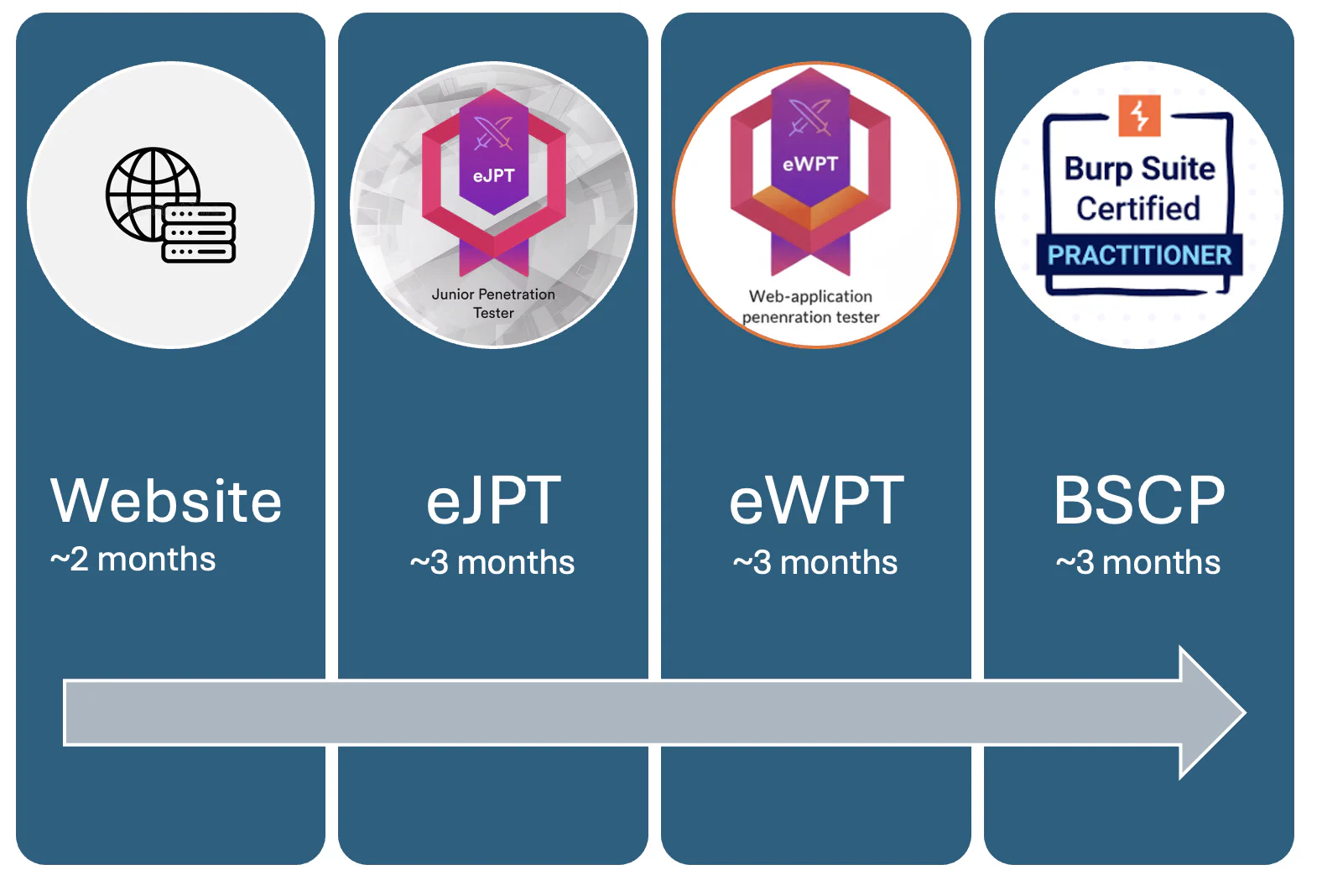
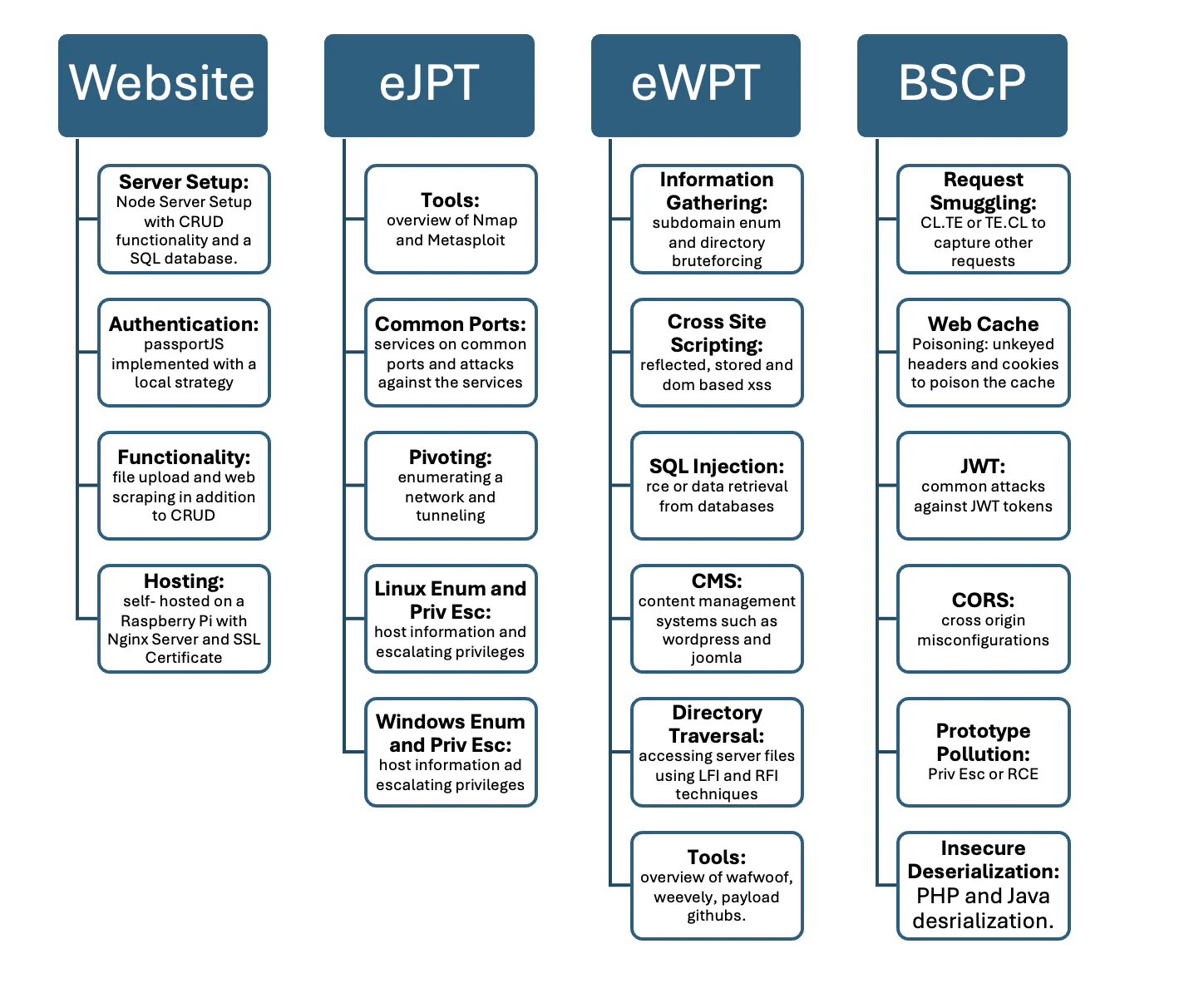
Building a website is one of the best ways to gain foundational knowledge for penetration testing, even though it doesn’t look like “security” at first.
When you build a website, you learn how the browser, server, and database interact with each other. This includes:
The guide below shows you how to set up a NodeJS server with a MySQL Database to perform CRUD functions.
Explore how to setup a basic server
We build on the basic server by allowing multiple users to access the app through a registration page where users can create profiles. The profiles are managed through sessions implemented by the PassportJS library.
Explore how to configure authentication
The functionality is extended by allowing users to upload files and also pulling information from a different website using a web scraper.
Extended functionality including File Upload and Web Scraping
Finally we will configure a Nginx Server on a Raspberry Pi to serve our site. We will also enable SSL on the Nginx server with a free dynamic domain.
Self-Hosting the Website on a Raspberry Pi
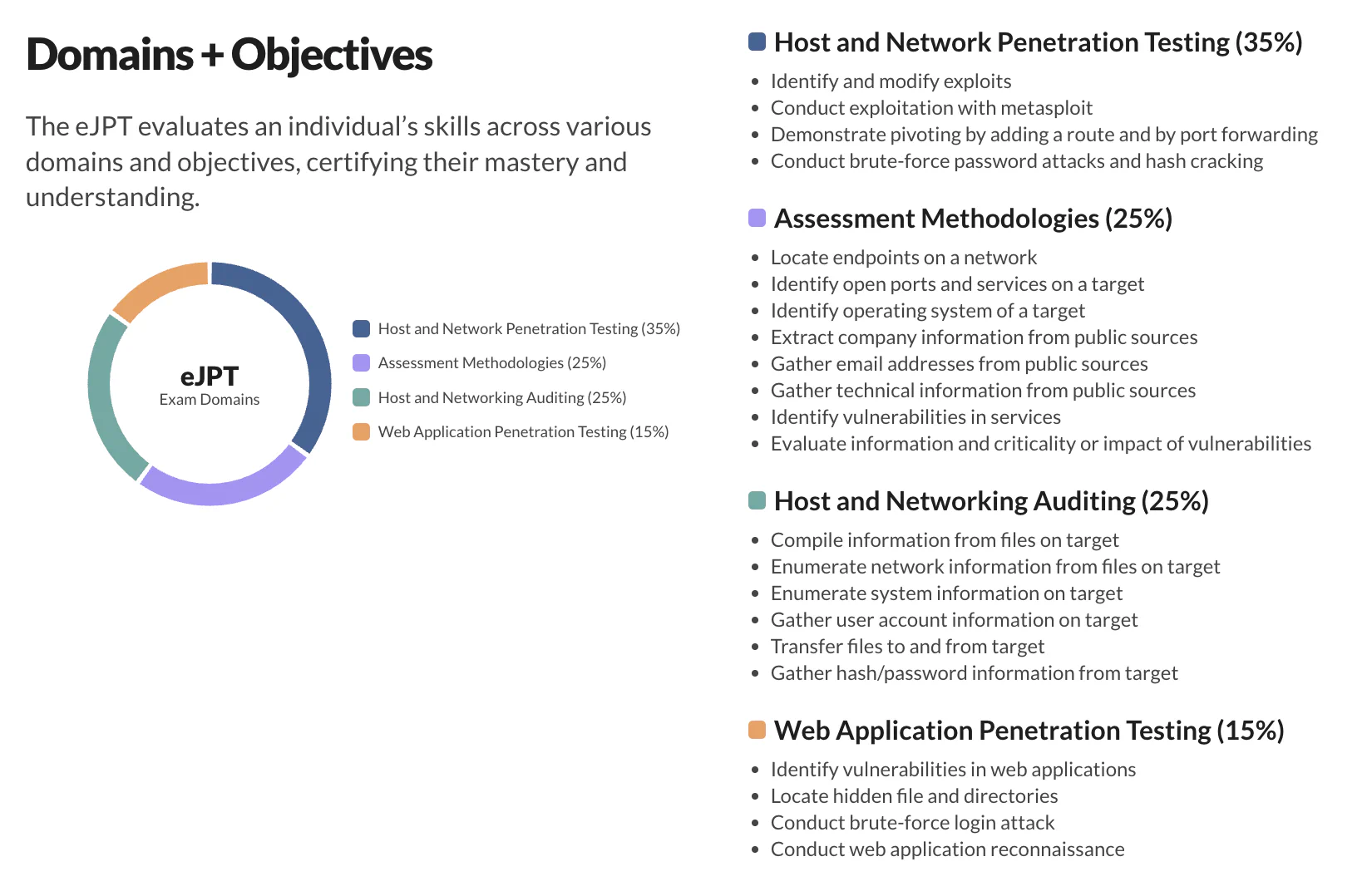
Once strong foundations are built in the web domain and there is a complete understanding of how websites work. The next step is exposure to security concepts and building a core pentesting methedology. The eJPT is a certification with more than 148-hours of training content and a 48 hour exam which provides real-world pentesting capabilities.
The eJPT introduces the following concepts:
The eJPT (eLearnSecurity Junior Penetration Tester) is important for pentesting because it provides structure, fundamentals, and real-world context at the very beginning of a pentester’s journey. Mimicking real-world scenarios and packed with dozens of practical labs, the eJPT builds skills required for hands-on engagements and affirms the individual’s capability to become an asset in any penetration testing team.
The exam is 48 hrs with 35 questions. There are 5–6 machines in DMZ and 1–2 machines in the internal network. You are required to pivot from the DMZ to the internal network and also escalate your priviledges.
An overview of tools such as Nmap and Metasploit
Services on Common Ports and Attacks against it
Establishing a pivot point to move through a network after initial access
Information Gathering on the compromised Linux host and increasing priviledges
Information Gathering on the compromised Windows host and increasing priviledges
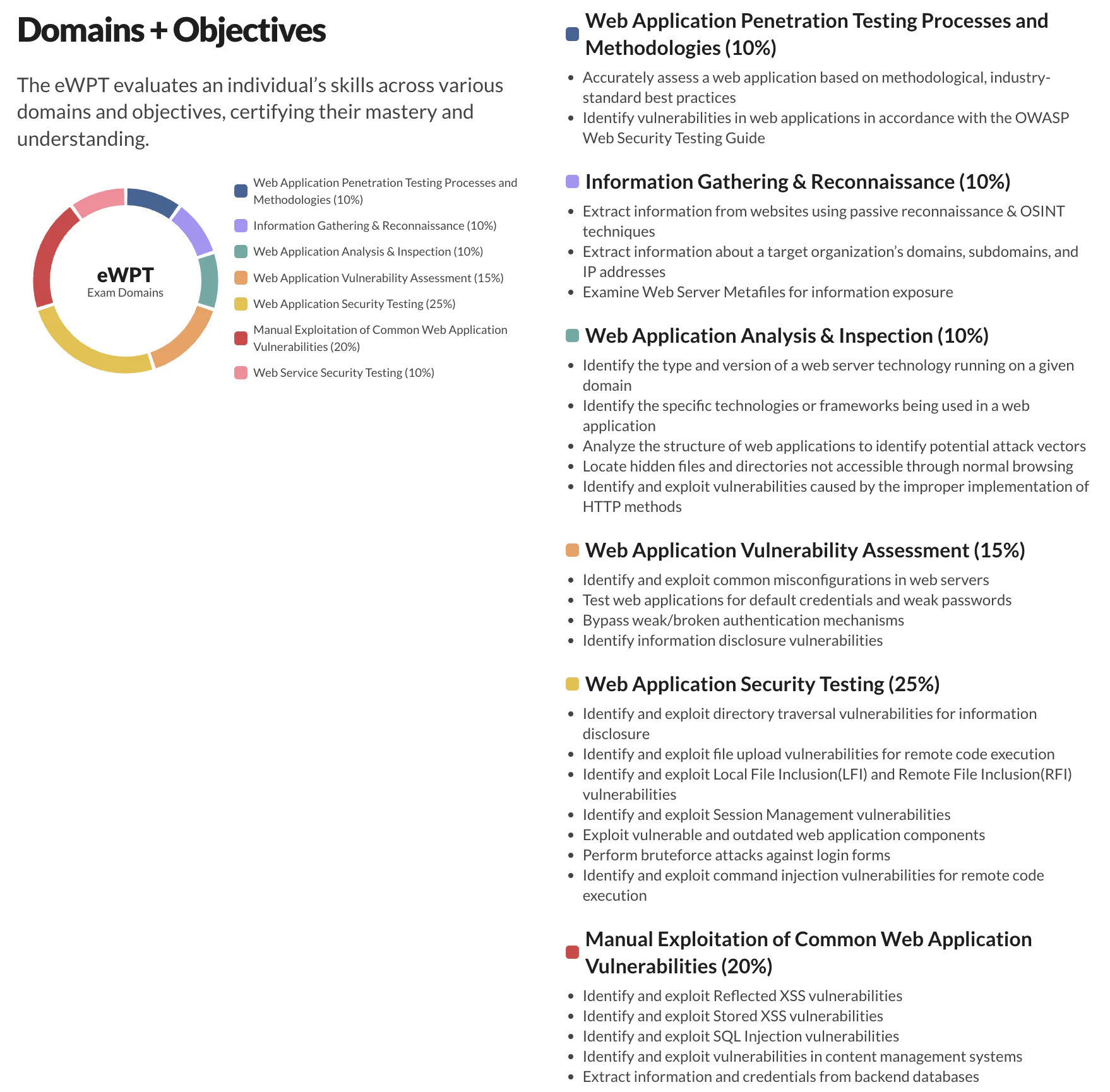
eWPT is a hands-on, professional-level Red Team certification that simulates skills utilized during real-world engagements. The exam environment presents a scenario of a web application pentests that you need to perform on a collection of end-points. You have 10 hours to test the applications and services found in scope and 50 questions to answer in that time. You will need an overall passing score of 75% or above to pass the exam. The questions consist of multiple choice and short answer questions. These are contextual to the exam environment and may change between exams as it produces dynamic ‘flags’ to collect. Make no mistake, this is not a CTF style exam. You need to perform a pentest to uncover the answers.
An overview of tools such as Nmap and Metasploit
Attaching code onto a legitimate website that will execute when the victim loads the website.
Code injection technique used to modify or retrieve data from SQL databases
Common attacks on CMS systems such as Wordpress and Joomla
Accessing unauthorized files and directories outside a web application's intended folder.
Exploring tools such as wafwoof and weeveley to automate attacks
The Burp Suite Certified Practitioner (BSCP) is an official certification for web security professionals, from the makers of Burp Suite. Becoming a Burp Suite Certified Practitioner demonstrates a deep knowledge of web security vulnerabilities. The certification consist of a collection of 300+ labs.
| Topic Category | Specific Topic | Approx. Number of Labs |
|---|---|---|
| Server‑Side Vulnerabilities | SQL Injection | 18 labs |
| Authentication | 14 labs | |
| Path Traversal (Directory Traversal) | 6 labs | |
| Command Injection | 5 labs | |
| Business Logic Vulnerabilities | 11 labs | |
| Information Disclosure | 5 labs | |
| Access Control | 13 labs | |
| File Upload Vulnerabilities | 7 labs | |
| Race Conditions | 6 labs | |
| Server‑Side Request Forgery (SSRF) | 7 labs | |
| XXE Injection | 9 labs | |
| NoSQL Injection | 4 labs | |
| Client‑Side Vulnerabilities | Cross‑Site Scripting (XSS) | 30 labs |
| Cross‑Site Request Forgery (CSRF) | 12 labs | |
| Cross‑Origin Resource Sharing (CORS) | 4 labs | |
| Clickjacking (UI Redressing) | 5 labs | |
| DOM‑Based Vulnerabilities | 7 labs | |
| WebSockets | 3 labs | |
| Advanced / Other Topics | Insecure Deserialization | 10 labs |
| GraphQL API Vulnerabilities | 5 labs | |
| Server‑Side Template Injection | 7 labs | |
| Web Cache Poisoning | 13 labs | |
| HTTP Host Header Attacks | 7 labs | |
| HTTP Request Smuggling | 22 labs | |
| OAuth Authentication | 6 labs | |
| JWT Attacks | 8 labs | |
| Prototype Pollution | 10 labs | |
| Web LLM Attacks | 4 labs | |
| Essential Skills | 2 labs |
An attack in which the web server and a proxy/load balancer disagree about where one HTTP request ends and the next begins. This lets the attacker “smuggle” a hidden request through the system.
Web cache Poisoning - the cache stores a malicious or incorrect response, which is then served to many users. Web Cache Deception - the cache stores private or sensitive content as if it were public.
Misconfigurations in the configurations of JWT/oAuth expose security vulnerabilities.
The implementation of CORS may contain mistakes or be overly lenient to ensure that everything works, and this can result in exploitable vulnerabilities.
It enables attackers to add arbitrary properties to global object prototypes, which may then be inherited by user-defined objects.
Insecure deserialization is when user-controllable data is deserialized by a website.
This roadmap represents a strong foundation in both web development and penetration testing, starting from building a solid understanding of how websites work, then progressing through structured learning paths such as eJPT, eWPT, and BSCP. However, it’s important to understand that penetration testing is a field of continuous learning. This roadmap is not the end, but rather a starting point. Technology evolves, new vulnerabilities emerge, and attack techniques constantly change. Future topics to expand this roadmap include Active Directory and Mobile Security.